 seolounge
For international finance decision-makers and foreign companies, entering the Bangladesh market requires a rigorous assessment of local financial health. Whether you are planning a joint venture or an acquisition, understanding local statutory requirements is critical to mitigating risk. By leveraging comprehensive cross-border M&A advisory services, foreign entities can uncover hidden tax liabilities, verify asset valuations, and ensure full compliance with Bangladesh regulatory frameworks before finalizing any transaction.
Key Due Diligence Focus Areas for Foreign Companies in Bangladesh
Assessing Local Tax Liabilities: Evaluating historical compliance with the National Board of Revenue (NBR) and VAT regulations to prevent inherited corporate debt. This often requires expert corporate taxation services guidance.
Verifying Asset Quality and Cash Flow: Ensuring that the target Bangladeshi company’s reported financial statements accurately reflect their operational reality and align with international accounting standards.
Foreign Exchange and Repatriation Checks: Analyzing the target company’s financial structure to ensure future profits and dividends can be legally repatriated to your foreign headquarters.
Facts You Shouldn’t Miss About Financial Due Diligence
An investigation into a company’s financial issues is known as financial due diligence. Due diligence is similar to an audit in that it is performed by outsiders who seek to better understand the company’s financial position and future prospects. Financial due diligence also aims to find problems that aren’t immediately obvious in the financial statements.
Discover essential facts about financial due diligence in this informative two-line description. Learn why it’s a crucial step in business transactions, providing invaluable insights into a target company’s financial health, risks, and opportunities for value creation.
Prospective buyers should undertake their own financial due diligence on purchases under $1 million because it is more cost-effective.
Key Takeaways:
Financial Due Diligence (FDD) verifies a company’s real financial health, risks, valuation, and future earning potential.
FDD should ideally cost no more than 1% of the total transaction value.
The FDD process begins after signing the Letter of Intent (LOI).
Typical FDD duration: 4–6 weeks, depending on the seller’s financial documentation.
Buy-side FDD helps investors confirm value; Sell-side FDD helps sellers fix issues before buyers find them.
FDD focuses on quality of earnings, cash flow, liabilities, market performance, and financial risks.
Unlike an audit, FDD is future-focused, strategic, and customized for the buyer’s investment decision.
Hiring professional FDD experts ensures fraud detection, accurate valuation, fast closing, and investor confidence.
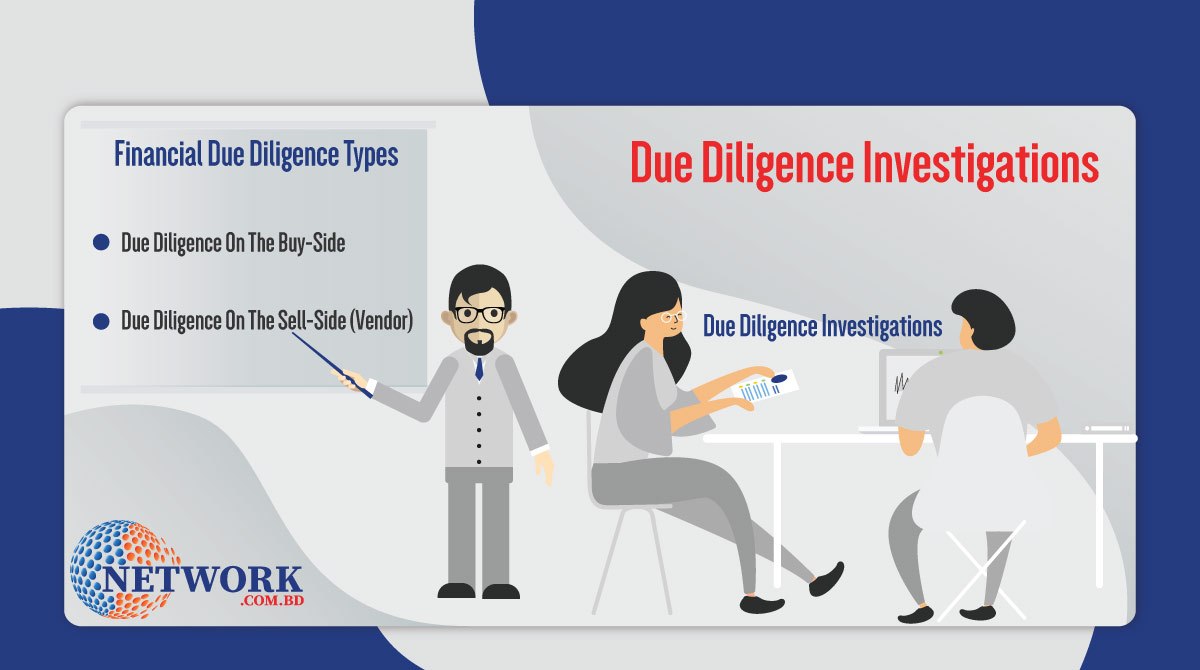
Financial Due Diligence Types
1. Due Diligence On The Buy-Side
An acquirer or buyer who intends to purchase the target company in issue conducts this type of FDD. A buyer could be a private equity firm, a venture capitalist, a strategic investor, an investment bank, a family office, a pension fund, an insurance company, or something else entirely.
Buy-side The financial soundness of the target company is the primary focus of the FDD. It entails compiling data on the company’s revenues, expenses, balance sheet, debtors and creditors, growth rate, and market share, among other things.
2. Due Diligence On The Sell-Side (Vendor)
Sell-side A seller or vendor selling a business, on the other hand, completes an FDD. This procedure focuses on areas of interest for potential acquirers or purchasers, ensuring that the transaction goes smoothly.
A sell-side analyst Financial Due Diligence assists the seller through an internal audit, assisting in the discovery of flaws that would otherwise go unnoticed.

Financial Due Diligence Vs Audit: What’s The Difference?
Due diligence aids the buyer in determining the target company’s financial soundness. An audit, on the other hand, provides assurance about the target company’s financial accounts.
Here are some more significant distinctions between FDD and audit:
| Financial Due Diligence | Audit |
| 1. The vendor’s scope and procedure were determined and agreed upon. | 1. The country’s rules and regulations determine the scope and procedure. |
| 2. Does not verify the accuracy of the material available. | 2. The accuracy of the data is checked. |
| 3. Think about the future. | 3. Focuses primarily on historical data. |
| 4. Analyzes the earnings quality. | 4. Examine the balance sheet. |
Why International Investors Require Strategic Financial Due Diligence
Engaging in strategic financial due diligence services provides foreign stakeholders with the exact financial clarity needed to negotiate accurate purchase prices and avoid post-acquisition financial disputes.
Financial Due Diligence provides:
Real business valuation
Future earning predictions
Cash flow and debt health insights
Identification of fraud or misstatements
A complete understanding of risks
Stronger negotiation power
Without FDD, investors risk overpaying or acquiring a financially unstable company.
The Advantages
There are numbers of advantages to mention:
1. Determine whether there are any potential dangers linked with the chosen company.
2. Evaluate the acquisition’s viability.
3. Recognize the target company’s genuine worth.
4. Prior to signing a purchase agreement, identify the concerns that need to be addressed.
5. Confirm that the buyer has sufficient funds to finish the transaction.
Why Should You Hire A Professional To Perform Financial Due Diligence?
1. Close the deal as soon as possible. Buyers often spend weeks coming up to closing acquiring funds and drafting a purchase agreement, leaving little time for thorough due research.
2. Instill trust in your investors. Hiring independent third-party expertise instills confidence in your investors.
3. Financial statements that are dishonest should be avoided. Professionals that are experienced with deceitful accounting can spot errors fast and simply.
4. To ensure that no stone is left unturned, professionals apply their expert judgment, smart analysis, and a detailed due diligence checklist.
Conclusion
Conducting thorough financial due diligence in Bangladesh is not a process you should handle remotely without local expertise. From deep-dive financial audits performed by our expert business accounting services team to post-merger integration and seamless Bangladesh company incorporation services, securing the right local partner is the key to your international expansion’s success.
Frequently Asked Questions
What financial statements are reviewed in Financial Due Diligence?
FDD typically reviews income statements, balance sheets, cash flow statements, tax filings, bank statements, and notes to accounts for the past 3–5 years.
How does Financial Due Diligence affect business valuation?
FDD can increase or decrease valuation based on revenue quality, profit margins, liabilities, cash flow strength, tax risks, and operational stability.
Does Financial Due Diligence include tax review?
Yes. FDD includes checking tax filings, unpaid taxes, compliance issues, and potential penalties that may affect the deal.
Can Financial Due Diligence detect cash flow problems?
Yes. FDD analyzes operating cash flow, free cash flow, and cash management practices to identify liquidity issues.
Is Financial Due Diligence required for startups?
Yes. Investors use FDD to validate revenue models, cash burn rate, expenses, projections, and the financial sustainability of the startup.
⭐ Follow Us:-
📱 ফেসবুক: https://www.facebook.com/network.com.bd/
🐦 X (Formerly Twitter): https://x.com/Networkbd1
📸 Instagram: https://www.instagram.com/networkbd1/
💼 LinkedIn: https://www.linkedin.com/company/network-com-bd/
