 seolounge

Labour Law Compliance
Bangladesh Labour Law Compliance
Bangladesh labour law compliance means meeting the Bangladesh Labour Act 2006 as amended by the Bangladesh Labour (Amendment) Act 2026 (Act 43 of 2026), which raised festival holidays from 11 to 13 days and set maternity leave at 60 days before and 60 days after childbirth (s.118, s.46). We check your office, factory or export processing zone (EPZ) unit against the law that applies to it, then fix the contracts, registers and policies that fall short. A gap check starts from USD 900 per establishment and takes 2 weeks.
- Festival holidays, s.118
- 13 days
- Maternity leave, s.46
- 60 + 60 days
- Notice, monthly worker, s.26
- 120 days
- Need a safety committee, s.90A
- 50+ workers
Labour Law Compliance Services, Office or Plant
Six areas we check at every office, factory and EPZ unit, each tied to its section of the law.
Contracts and probation
Each worker needs a written appointment letter. Probation is 6 months for clerical staff and 3 months for others; after it, a worker counts as permanent without a confirmation letter (s.4(8)). Our guide to conditions of employment under the Labour Act explains each term.
Working hours and overtime
Work is capped at 8 hours a day and 48 a week, or 10 and 60 with overtime, averaging at most 56 a week over a year (s.100–102). Overtime pays twice the ordinary rate of basic wage, dearness allowance and ad hoc wage (s.108).
Leave and festival holidays
Workers get 10 days of casual leave, 14 days of sick leave on full wages, 1 day of annual leave for every 18 days worked and 13 festival holidays, up from 11 (s.115–118). A leave policy that still shows 11 needs updating.
Safety committee and workplace conduct
Every establishment with 50 or more workers needs a safety committee (s.90A). The 2026 amendment also defines forced labour (s.2(12A)) and requires a policy against workplace violence and harassment (s.332A), with fines of Tk 20,000 to 50,000 for breaches (s.307A, s.307B).
Ending employment and final dues
Ending a permanent worker's job without cause takes 120 days' notice for monthly-rated workers and 60 days for others, plus 30 days' wages, or gratuity if higher, for each completed year of service (s.26). Final dues are paid within 30 working days (s.30).
Offices, factories and EPZ units
A unit inside an EPZ follows the Bangladesh EPZ Labour Act 2019, not the Labour Act 2006: workers form welfare associations instead of trade unions, and final dues are paid within 15 working days. We check each site against the law that applies to it.
Your Labour File: Contracts, Registers, Policies
Everything is written in English for your head office. Your employee files hold personal data, so we keep them in line with data protection readiness in Bangladesh.
- A gap report that lists each Labour Act section, what your records show and what has to change, ranked by risk.
- Updated appointment letter and contract templates for each worker category, with probation and notice terms that match s.4(8) and s.26.
- A leave policy and service rules updated for 13 festival holidays, 60 + 60 days of maternity leave and the 2026 annual leave rules.
- Attendance, overtime, leave and wage registers set up so an inspector can check them on the spot.
- Safety committee papers for establishments with 50 or more workers, and a workplace violence and harassment policy.
- A licence register showing your factory or establishment licence and each contractor agency licence with its renewal date.
Our work process
From Records to Ready File
We start from your own records, then fix contracts, registers and policies so the labour file matches the Act as amended in 2026.
Send your company details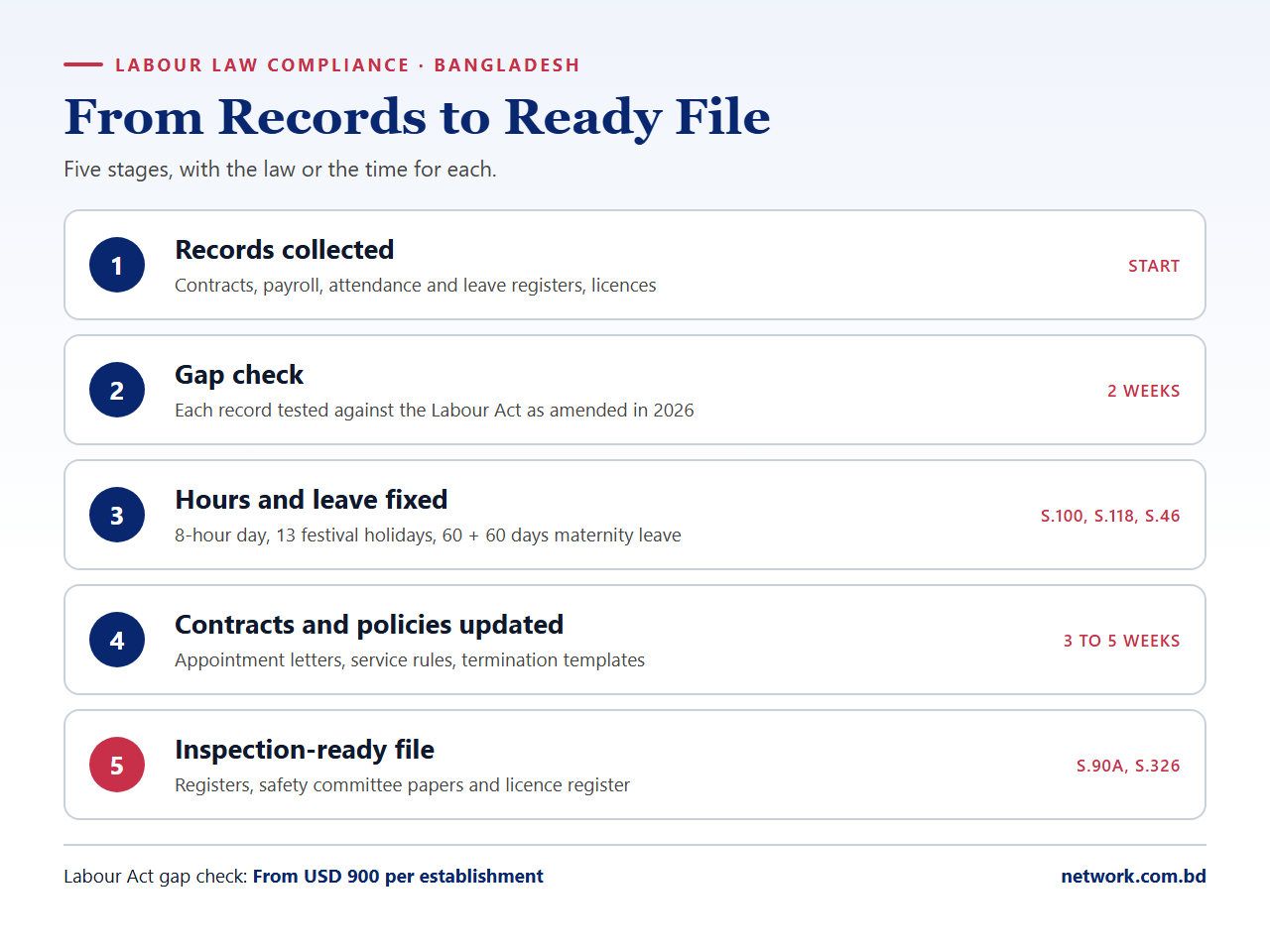
Labour Act Gap Check, Then Fixes on Site
Six steps from your records to an inspection-ready file. Foreign managers on your payroll also need work permits in Bangladesh, which we handle as a separate service.
- Step 1 You send headcount by site, appointment letters, service rules, payroll, attendance and leave registers, and copies of your licences.
- Step 2 We confirm which law applies to each site: the Labour Act 2006 or, for an EPZ unit, the EPZ Labour Act 2019.
- Step 3 We test each record against its section, from working hours (s.100–102) to final dues (s.30), and deliver the gap report in 2 weeks.
- Step 4 You review the report with us and decide which fixes we make and which your own team makes.
- Step 5 We update contracts, policies and registers, and visit the site to check notices and registers where needed.
- Step 6 On retainer, we re-check your registers and send your head office an English note when the law or a wage rate changes.
Labor Law Compliance Cost per Establishment
Four services, priced in US dollars before value added tax (VAT). A typical first year with a gap check, the update pack and a 12-month retainer comes to USD 3,900 (900 + 1,200 + 12 × 150).
| Service | Starting Price | Scope | What changes the price |
|---|---|---|---|
| Labour Act gap check | From USD 900 per establishment | Up to 100 workers; section-by-section review of contracts, hours, leave, termination, safety committee and licences, with a written gap report | Headcount, number of sites, office or factory, EPZ unit |
| Labour file update pack | From USD 1,200 | Appointment letters, service rules, leave and termination templates and policies updated to Act 43 of 2026 | Number of worker categories and documents to rewrite |
| Labour compliance retainer | From USD 150 per month | Register checks, English notes on law and wage changes, answers to day-to-day labour questions | Headcount and number of sites |
| Inspection-readiness visit | From USD 300 per visit | On-site check of registers, notices and committee papers before a Department of Inspection for Factories and Establishments (DIFE) inspection | Site location and size |
Factories with more than 100 workers get a written quote. This is readiness and filing support, not legal advice; a partner lawyer reviews on request. Prices exclude VAT, government fees and third-party fees, which are billed at cost. We send a written quote within 24 hours.
Get a labour compliance quoteAmendment Act 2026 Updates in 3 to 5 Weeks
Bringing your labour file in line with the Bangladesh Labour (Amendment) Act 2026 runs in three stages.
- Gap check and written report2 weeks
- Contracts, policies and registers updatedAfter the report
- Your review and sign-offSet by your team
- Full update, start to finish3 to 5 weeks
What speeds up the work? Send all appointment letters, registers and licences in one batch, and name one person who can approve the new templates.
Leave, Overtime and Notice: The Legal Minimums
The minimums below come from the Bangladesh Labour Act 2006, as amended by Act 43 of 2026; the last row shows where an EPZ unit differs.
| Rule | Legal minimum | Law and section |
|---|---|---|
| Working hours | 8 hours a day and 48 a week; up to 10 a day and 60 a week with overtime, averaging no more than 56 a week over a year; a 1-hour break in a day of more than 6 hours | Labour Act 2006, s.100–102 |
| Overtime pay | Twice the ordinary rate of basic wage, dearness allowance and ad hoc wage | Labour Act 2006, s.108 |
| Weekly holiday | 1 day in a factory or industrial establishment; 1.5 days in a shop or commercial establishment | Labour Act 2006, s.103 |
| Casual and sick leave | 10 days casual; 14 days sick on full wages | Labour Act 2006, s.115, s.116 |
| Annual leave | 1 day for every 18 days worked (adults); 1 day for every 14 days for under-age workers in a factory | Labour Act 2006, s.117, as amended in 2026 |
| Festival holidays | 13 days with wages (was 11); a worker who works on one gets 1 substitute day plus 2 days' wages | Labour Act 2006, s.118, as amended in 2026 |
| Maternity leave | 60 days before and 60 days after childbirth (was 8 + 8 weeks), for a worker with 6 months' service | Labour Act 2006, s.46, s.47(3), as amended in 2026 |
| Probation | 6 months for clerical staff, 3 months for others (a skilled worker's can be extended by 3 months); permanent even without a confirmation letter | Labour Act 2006, s.4(8) |
| Ending a permanent job without cause | 120 days' notice (monthly-rated) or 60 days (others), plus 30 days' wages or gratuity, whichever is higher, per completed year | Labour Act 2006, s.26 |
| Final dues | Within 30 working days | Labour Act 2006, s.30 |
| Minimum wage review | Rates reviewed by the Minimum Wage Board every 3 years (was 5) | Labour Act 2006, s.138, s.139(6), as amended in 2026 |
| Safety committee | Every establishment with 50 or more workers | Labour Act 2006, s.90A, as amended in 2026 |
| Provident fund (PF) | With 100 or more permanent workers, mandatory if two-thirds ask in writing; 7–8% of basic wage from each side | Labour Act 2006, s.264 |
| Workers' Profit Participation Fund (WPPF) | Where it applies: 5% of net profit, split 80:10:10 between participation, welfare and foundation, within 9 months of the year-end | Labour Act 2006, s.234 |
| Factory and contractor agency licences | Factory or establishment licence renewed every 5 years; contractor agency licence every year | Labour Act 2006, s.326(1)(b), as amended in 2026 |
| EPZ unit (different law) | Workers' welfare association instead of a trade union; 8 hours a day, 10 with overtime; final dues within 15 working days | Bangladesh EPZ Labour Act 2019 (Act 2 of 2019) |
Example: A Dhaka office brought in line with the 2026 amendment. A foreign-owned office in Dhaka still uses a leave policy and appointment letters written before the amendment, showing 11 festival holidays and 8 weeks of maternity leave before and after childbirth. The gap check marks each line against s.118 and s.46, the update pack replaces the policy and the templates, and the registers are set up so an inspection finds the new rules applied.
Sources: Bangladesh Labour Act 2006 (Act 42 of 2006) s.4(8), s.26, s.30, s.46–47, s.90A, s.100–103, s.108, s.115–118, s.138–139, s.234, s.264, s.326, as amended by the Bangladesh Labour (Amendment) Act 2026 (Act 43 of 2026); Bangladesh EPZ Labour Act 2019 (Act 2 of 2019). The statutes are published in Bangla on bdlaws; the English wording here is our summary, and Bangla section letters are written in Latin form (for example s.90A). Reviewed by Romana Akther Shila, 19+ years in HR and administration, NetworkBD.
Bangladesh Labour Law Questions From Employers
What changed in Bangladesh labour law in 2026 for employers?
There is no new Labour Act. The Bangladesh Labour Act 2006 was amended by the Bangladesh Labour (Amendment) Act 2026 (Act 43 of 2026), in force at once. Festival holidays rose to 13 days (s.118), maternity leave became 60 days before and 60 after childbirth (s.46), minimum wages are reviewed every 3 years (s.139(6)), contractor agency licences are renewed yearly (s.326) and forced labour is now defined, with fines of Tk 20,000 to 50,000 (s.2(12A), s.307B).
How many festival holidays and how much maternity leave are required in Bangladesh?
Thirteen festival holidays a year with wages, and 120 days of maternity leave split as 60 days before and 60 days after childbirth. Both changed in 2026 (Labour Act 2006, s.118 and s.46, as amended by Act 43 of 2026). A worker who works on a festival holiday gets one substitute day plus two days' wages. Maternity benefit needs at least 6 months' service with the employer (s.47(3)).
What notice and compensation apply when ending a permanent worker's job?
If the employer ends the job without cause, it gives 120 days' notice to a monthly-rated permanent worker and 60 days to other permanent workers, and pays 30 days' wages, or gratuity if that is higher, for each completed year of service (Labour Act 2006, s.26). A permanent worker who resigns gives 60 days' notice (s.27). All final dues are paid within 30 working days (s.30).
Does the Bangladesh Labour Act apply to factories in an EPZ?
No, a unit inside an export processing zone follows its own law, the Bangladesh EPZ Labour Act 2019 (Act 2 of 2019). Workers there form a workers' welfare association rather than a trade union, and final dues are paid within 15 working days instead of the 30 working days in the Labour Act 2006. Hours are similar: 8 a day, up to 10 with overtime. We check each site against the law that applies to it.
When must we form a safety committee or a provident fund?
A safety committee is needed in every establishment with 50 or more workers (Labour Act 2006, s.90A, as amended in 2026). A provident fund becomes mandatory in an establishment with 100 or more permanent workers when two-thirds of them ask for it in writing; contributions are 7–8% of basic wage from both worker and employer (s.264). The gap check confirms whether either rule applies to each site.
What is the minimum wage in Bangladesh?
It depends on the sector, so we do not quote a single figure. Rates are set sector by sector on the recommendation of the Minimum Wage Board and, since the 2026 amendment, reviewed every 3 years instead of every 5 (Labour Act 2006, s.138, s.139(6)). During the gap check we compare your pay scales with the current official rate for your sector and flag any shortfall.
Who can check our office or factory against the Labour Act?
NetworkBD runs a Labour Act gap check for offices, factories and EPZ units, from USD 900 per establishment of up to 100 workers, with a written report in 2 weeks. We then update contracts, policies and registers in 3 to 5 weeks in total. This is readiness support, not legal advice; a partner lawyer reviews on request. Larger factories get a written quote within 24 hours.
Labour Inspection Ready, Registers in Order
Tell us your headcount, your sites and whether any unit sits in an EPZ, and we will scope the gap check. We send a written quote within 24 hours.